Start Your Business with Confidence
From company incorporation to ongoing company secretarial services, SASCO helps Malaysian SMEs understand their compliance requirements with practical, straightforward advice.
Contact Us WhatsApp Us
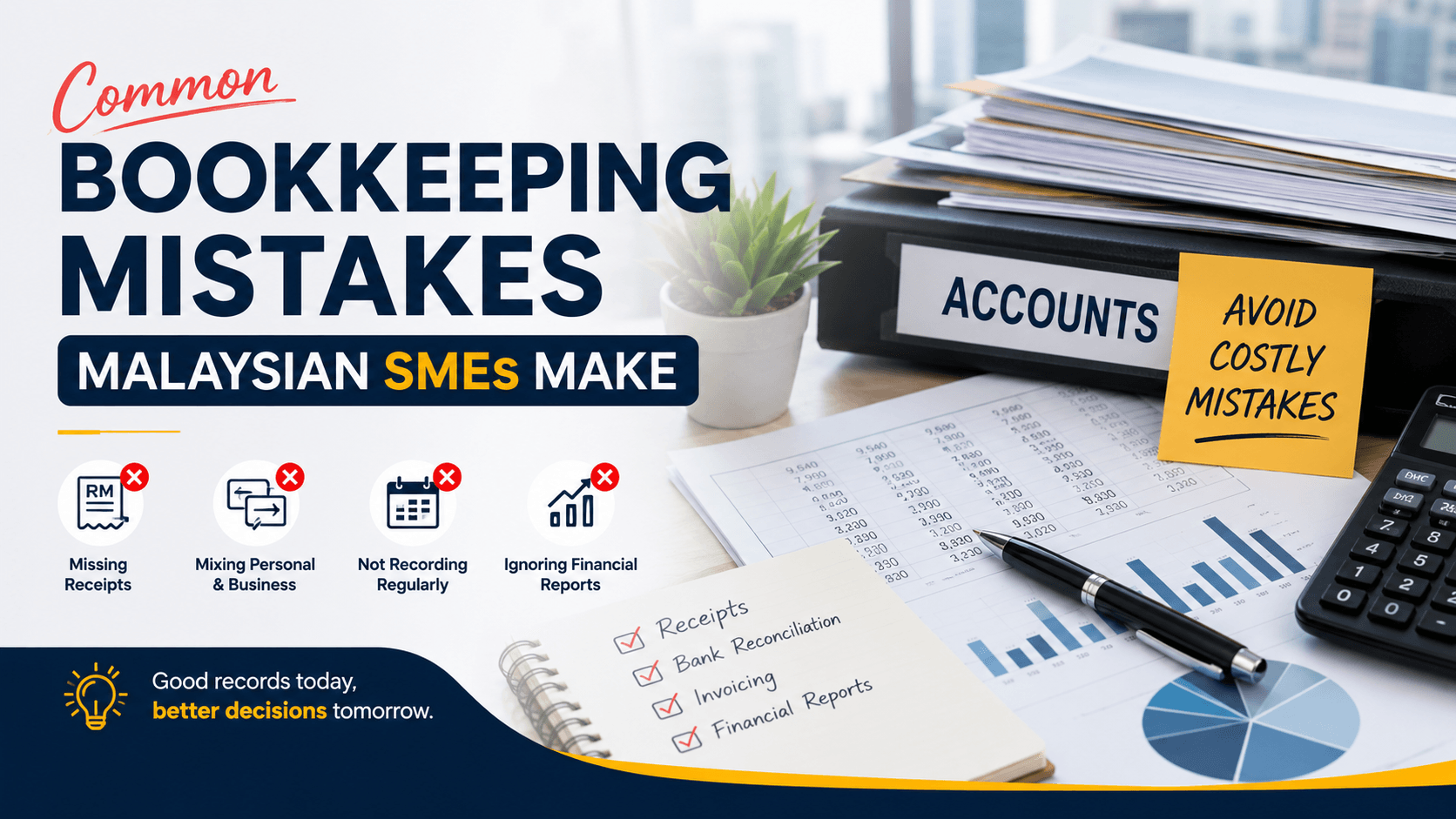
Running a small or medium-sized business in Malaysia involves much more than making sales. Good financial records are essential for understanding your business performance, managing cash flow, preparing taxes, and staying compliant with reporting requirements.
However, bookkeeping is often pushed aside because business owners are busy handling customers, operations, and growth. Small mistakes may seem harmless at first, but they can lead to inaccurate financial reports, unnecessary stress during tax season, or missed compliance obligations.
This guide explains the most common bookkeeping mistakes Malaysian SMEs make, why they matter, and how proper accounting and bookkeeping services can help businesses stay organised and make better financial decisions.
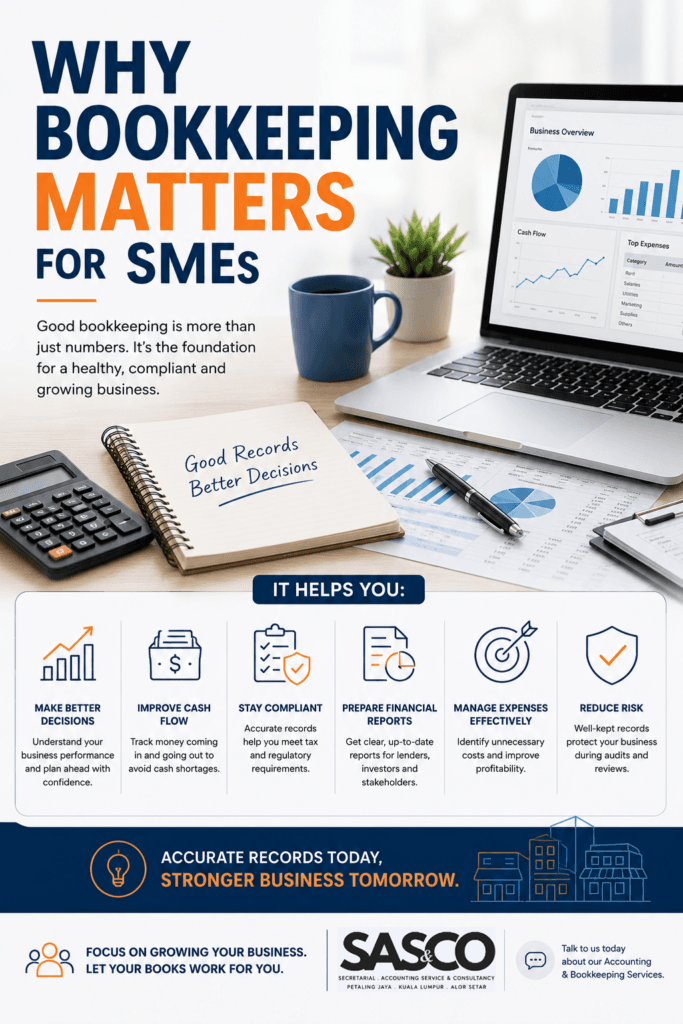
Why Bookkeeping Matters for SMEs
Bookkeeping is the process of recording your business’s financial transactions, including sales, expenses, payments, and receipts.
Accurate bookkeeping helps you:
- Know whether your business is making a profit
- Monitor cash flow
- Prepare financial statements
- Support tax reporting
- Make informed business decisions
- Keep proper records for audits or regulatory reviews
Without reliable bookkeeping, business owners are often making decisions based on incomplete or outdated information.
1. Mixing Personal and Business Expenses
One of the most common mistakes among SME owners is using the same bank account or credit card for both personal and business spending.
Examples include:
- Paying personal bills using company funds
- Buying business supplies with a personal account without proper records
- Transferring money between accounts without documentation
Why this is a problem
When personal and business expenses are mixed together, it becomes difficult to:
- Calculate actual business profits
- Prepare accurate financial statements
- Identify deductible business expenses
- Track company cash flow
Best practice
Maintain separate bank accounts for your business and personal finances. Keep receipts and record every business transaction clearly.
2. Not Recording Transactions Regularly
Some businesses only update their books once every few months—or even just before tax filing.
By then:
- Receipts may be missing
- Transactions are forgotten
- Bank reconciliations become more difficult
Better approach
Update your bookkeeping weekly or monthly instead of leaving everything until year-end.
Using cloud accounting software also makes regular bookkeeping much easier.
3. Losing Receipts and Supporting Documents
Invoices, payment vouchers, supplier bills, and receipts all support your financial records.
Without proper documentation:
- Expenses may not be traceable
- Financial reports become less reliable
- Preparing for audits or tax reviews becomes more challenging
Good practice
Store documents digitally whenever possible and organise them by month or category.
Many accounting software solutions allow receipts to be uploaded directly into the system.
4. Ignoring Bank Reconciliation
Bank reconciliation means comparing your accounting records with your bank statements.
Many SMEs skip this step, assuming the balances are correct.
However, reconciliation helps identify:
- Missing transactions
- Duplicate entries
- Incorrect amounts
- Bank charges
- Payment errors
Regular reconciliation improves the accuracy of your financial records.
5. Recording Expenses Under the Wrong Category
Not every expense belongs in the same category.
For example:
- Office supplies
- Marketing expenses
- Travel expenses
- Equipment purchases
Incorrect categorisation affects financial reports and makes it harder to understand where your business is actually spending money.
Consistent expense classification provides a clearer picture of business performance.
6. Delaying Invoicing
Some businesses wait weeks before sending invoices to customers.
Late invoicing often results in:
- Delayed customer payments
- Cash flow issues
- Difficulty tracking outstanding balances
Better practice
Issue invoices as soon as products are delivered or services are completed.
Regularly monitor unpaid invoices and follow up professionally.
7. Not Tracking Accounts Receivable and Payable
Many SME owners focus only on money currently in the bank.
However, it’s equally important to monitor:
Accounts Receivable
Money customers still owe your business.
Accounts Payable
Bills your business still needs to pay.
Tracking both helps you:
- Plan future cash flow
- Avoid late payment charges
- Improve collections
- Maintain healthy supplier relationships
8. Waiting Until Tax Season
Bookkeeping should not only happen when taxes are due.
Leaving everything until the last minute often means:
- Rushing through records
- Spending extra time finding missing documents
- Increased stress for business owners
Keeping your books updated throughout the year makes tax preparation much smoother.
If tax rates or filing deadlines are mentioned in your business planning, always before submission.
9. Not Reviewing Financial Reports
Some business owners have bookkeeping records but never review them.
Useful reports include:
- Profit and Loss Statement
- Balance Sheet
- Cash Flow Report
These reports help answer questions such as:
- Are sales growing?
- Which expenses are increasing?
- Is cash flow healthy?
- Can the business afford new investments?
Bookkeeping is most valuable when the information is used to support business decisions.
10. Trying to Handle Everything Alone
Many SME owners start by managing bookkeeping themselves.
While this may work in the early stages, the workload usually increases as the business grows.
More transactions mean:
- More invoices
- More expenses
- Payroll processing
- Tax reporting
- Financial reporting
- Compliance requirements
Outsourcing to experienced professionals allows business owners to spend more time focusing on customers and business growth while maintaining organised financial records.
What Can Happen If Bookkeeping Is Poor?
Poor bookkeeping doesn’t always cause immediate problems, but over time it can affect the health of your business.
Some common consequences include:
- Inaccurate financial reports
- Difficulty monitoring cash flow
- Poor budgeting decisions
- Missed tax preparation deadlines
- Time-consuming corrections later
- Reduced visibility into business performance
The longer bookkeeping issues remain unresolved, the more difficult they can be to correct.
How Professional Accounting and Bookkeeping Services Can Help
Professional accounting and bookkeeping services provide more than just recording transactions.
A reliable accounting partner can help you:
- Maintain accurate financial records
- Record transactions consistently
- Prepare management reports
- Reconcile bank accounts
- Organise supporting documents
- Support tax preparation
- Improve financial visibility for better decision-making
At SASCO, we work with Malaysian SMEs to simplify bookkeeping and accounting processes with practical, easy-to-understand guidance. Whether you’re a new business or an established company, our team helps keep your financial records organised so you can focus on running your business with greater confidence.
Looking for reliable Accounting & Bookkeeping Services? Contact SASCO to learn how our SME-focused team can support your day-to-day accounting needs and compliance requirements.
Frequently Asked Questions
Do all SMEs need bookkeeping?
Yes. Every business should maintain proper financial records, regardless of its size. Good bookkeeping supports daily operations, financial reporting, and tax preparation.
How often should bookkeeping be updated?
Ideally, bookkeeping should be updated weekly or monthly. Regular updates reduce errors and make financial reporting much easier.
What’s the difference between bookkeeping and accounting?
Bookkeeping focuses on recording financial transactions accurately. Accounting uses those records to prepare reports, analyse business performance, and support financial decision-making.
When should a business consider accounting and bookkeeping services?
Many SMEs choose professional accounting and bookkeeping services when transaction volumes increase, financial reporting becomes more complex, or business owners want to spend less time on administrative tasks and more time growing their business.
Further reading: Bookkeeping vs Accounting: What’s the Difference? and Cloud Accounting vs Traditional Bookkeeping: Which Is Better for SMEs?. For official reference, see Lembaga Hasil Dalam Negeri Malaysia (LHDN).
Apa Kata Pelanggan Kami
Rating 5.0 daripada 29 ulasan Google

I really appreciate the continuous support, clear guidance, and helpful advice given throughout the process. It has been a smooth and pleasant experience dealing with such a dedicated and committed team.
Thank you once again for all the support and outstanding service. Keep up the great work!