Start Your Business with Confidence
From company incorporation to ongoing company secretarial services, SASCO helps Malaysian SMEs understand their compliance requirements with practical, straightforward advice.
Contact Us WhatsApp Us
Reliable accounting for construction companies looks different from accounting in many other industries. Every project has its own timeline, budget, subcontractors, and payment schedule, and cash flow can change from month to month while project costs often continue long before the final payment is received.
Because of this, accounting for construction companies involves much more than recording income and expenses. Business owners need accurate project costing, proper financial records, tax compliance, and clear reporting to understand whether each project is actually making a profit.
Whether you run a construction company, renovation business, engineering firm, or specialised contractor, working with an accounting firm in Malaysia that understands project-based businesses can make financial management much easier.
This guide explains the accounting challenges construction companies commonly face and how industry-focused accounting support can help.
Why Construction Companies Need Specialised Accounting
Unlike businesses that sell products immediately, construction companies often manage projects over weeks or months, which means revenue and expenses may not happen at the same time.
Some common characteristics include:
- Multiple ongoing projects
- Progress payments from clients
- Advance purchases of materials
- Labour and subcontractor costs
- Retention sums
- Equipment and machinery expenses
- Project variations and additional work
Without proper accounting, it becomes difficult to answer important questions like:
- Which projects are profitable?
- Are project costs exceeding estimates?
- Is cash flow healthy enough for upcoming payments?
- Which clients have outstanding invoices?
- Are tax records properly maintained?
As a result, having organised financial information allows business owners to make better operational decisions instead of relying on estimates.
Common Accounting Challenges for Construction Companies
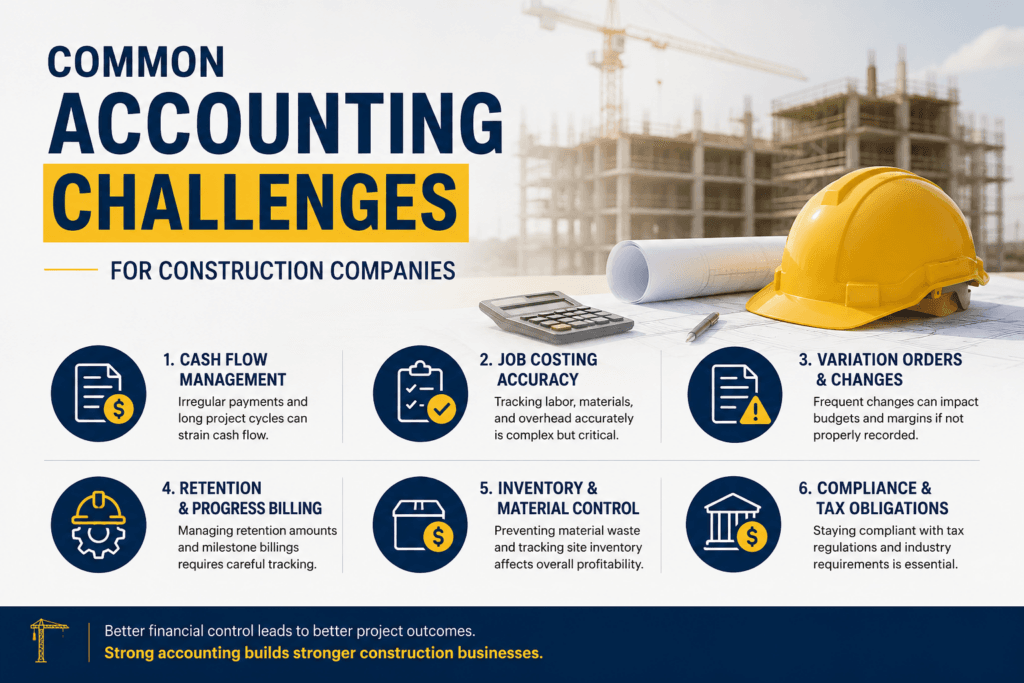
1. Tracking Project Costs Accurately
Every project has different expenses.
These may include:
- Building materials
- Labour wages
- Subcontractor fees
- Equipment rental
- Transportation
- Site expenses
- Professional services
If these costs are mixed together instead of being assigned to individual projects, it becomes difficult to measure actual profitability.
Overall, project-based accounting helps separate costs by project, making it easier to review performance after completion.
2. Managing Cash Flow
Many construction businesses experience strong sales but still face cash flow problems.
This often happens because:
- Clients pay according to project milestones
- Payment approvals may take time
- Material suppliers require earlier payment
- Payroll must continue regardless of payment collection
Without proper cash flow planning, businesses may struggle to meet operational commitments despite having ongoing projects.
In turn, regular financial reporting helps business owners anticipate upcoming cash requirements rather than reacting after problems occur.
3. Monitoring Project Profitability
Winning projects is only part of running a successful construction business.
It is equally important to know:
- Estimated profit
- Actual project cost
- Cost overruns
- Labour efficiency
- Material wastage
- Final project margin
Specifically, accurate accounting records allow management to compare estimated budgets with actual costs, helping improve future quotations and pricing decisions.
4. Managing Multiple Suppliers and Subcontractors
Construction projects often involve numerous suppliers and subcontractors.
This means handling:
- Purchase invoices
- Payment schedules
- Outstanding balances
- Progress claims
- Supporting documents
In short, a structured accounting process helps keep supplier records organised while reducing payment disputes and duplicated expenses.
5. Staying Compliant with Tax Requirements
Construction companies must also keep up with ongoing compliance responsibilities.
Depending on business activities, these may include:
- Corporate income tax
- SST obligations (where applicable)
- Payroll reporting
- EPF and SOCSO contributions
- e-Invoicing requirements
As compliance requirements continue to evolve, businesses should always verify current obligations with the relevant authorities.
What Good Accounting for Construction Companies Should Include
In fact, a reliable accounting system should provide more than bookkeeping.
It should help business owners understand the financial health of the business through:
Project Cost Tracking
Monitor costs for each project separately to measure actual performance.
Financial Reporting
Prepare monthly reports including:
- Profit & Loss
- Balance Sheet
- Cash Flow
- Project profitability reports
Together, these reports provide better visibility into business performance throughout the year.
Accounts Receivable Management
Track customer invoices and outstanding payments to improve collection efficiency.
Accounts Payable Management
Monitor supplier payments and avoid unnecessary late payment issues.
Payroll Support
Maintain accurate payroll records for employees while supporting statutory reporting requirements.
Tax Compliance
Prepare financial records required for tax filing and other reporting obligations.
Why Accurate Bookkeeping Matters in Construction
Bookkeeping is often overlooked until tax season.
However, for construction businesses, consistent bookkeeping provides day-to-day visibility over project finances.
Well-maintained bookkeeping helps:
- Record project expenses promptly
- Match invoices with projects
- Monitor supplier balances
- Prepare management reports faster
- Reduce year-end accounting adjustments
- Support audits when required
Instead of spending weeks organising receipts and invoices, with proper accounting for construction companies, businesses can maintain updated financial records throughout the year.
Risks of Poor Construction Accounting
Poor financial management can affect much more than compliance.
Some common risks include:
Underpricing Future Projects
Without accurate historical cost data, quotations may underestimate actual expenses.
Cash Flow Shortages
Projects may appear profitable on paper while cash is insufficient to pay suppliers or employees.
Missed Tax Obligations
In addition, incomplete records can delay tax preparation or increase the likelihood of reporting errors.
Limited Business Visibility
Business owners may not know:
- Which projects are profitable
- Which clients pay slowly
- Which expenses are increasing
- Whether the business is financially improving
Ultimately, good accounting provides the information needed for informed business decisions.
How SASCO Supports Construction Companies
At SASCO, we understand that construction businesses need accounting for construction companies that reflects how projects actually operate, not just standard bookkeeping.
Our industry-focused accounting and compliance services can help construction companies with:
- Professional bookkeeping
- Project-focused financial reporting
- Management accounts
- Corporate tax preparation
- SST compliance support (where applicable)
- Payroll processing
- e-Invoice readiness and implementation support
- Financial record organisation for growing businesses
Rather than simply preparing reports, our goal is to provide clear financial information that helps business owners manage projects with greater confidence while staying compliant with Malaysian reporting requirements.
Whether you are an established contractor or a growing construction SME, SASCO provides practical accounting support tailored to project-based businesses.
Looking for an accounting partner who understands the construction industry? Contact SASCO to learn how our industry-specific Accounting & Compliance services can support your business.
Frequently Asked Questions
Do construction companies need specialised accounting for construction companies?
Yes. Construction businesses typically manage multiple projects, progress payments, subcontractors, and varying project costs. Industry-specific accounting helps provide better visibility into project profitability and cash flow.
Can an accounting firm in Malaysia help manage project costs?
Yes. An experienced accounting firm in Malaysia can organise project expenses, prepare financial reports, monitor cash flow, and maintain accurate accounting records to support better decision-making.
How often should construction companies update their accounts?
Monthly bookkeeping is generally recommended. Regular updates provide timely financial reports and make tax preparation, payroll, and compliance much easier throughout the year.
Can outsourced accounting work for small construction companies?
Yes. Many SMEs outsource accounting for construction companies to gain professional financial support without hiring a full in-house finance team. This can improve record keeping, reporting, and compliance while allowing business owners to focus on project delivery.
Further reading: Perkhidmatan Perakaunan SASCO and Compliance Support for Professional Services Firms. For official reference, see Lembaga Pembangunan Industri Pembinaan Malaysia (CIDB).
Apa Kata Pelanggan Kami
Rating 5.0 daripada 29 ulasan Google

I really appreciate the continuous support, clear guidance, and helpful advice given throughout the process. It has been a smooth and pleasant experience dealing with such a dedicated and committed team.
Thank you once again for all the support and outstanding service. Keep up the great work!