Who Needs to Issue a CP58?
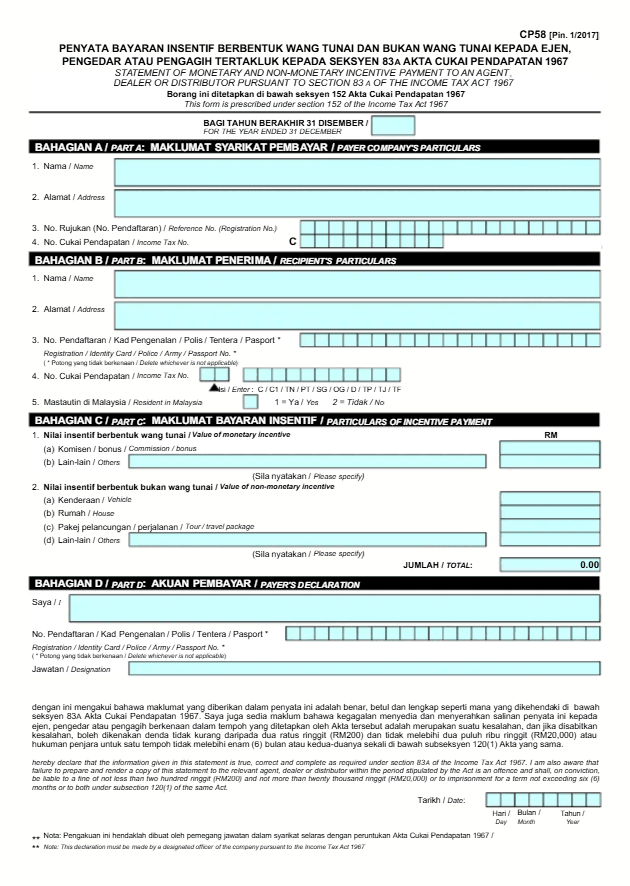
A business may need to issue a CP58 if it pays commissions or incentives to people who are not on its payroll.
Common examples include:
- Insurance agents
- Property agents
- Sales agents
- Dealers
- Distributors
- Freelance sales representatives
- Referral partners receiving commissions
If your company regularly rewards external parties for generating sales or business, CP58 may be applicable.
Who Receives a CP58?
Recipients are generally individuals who earn income from commissions or incentives but are not employees of the business.
Examples include:
- Independent agents
- Commission-based salespersons
- Dealers
- Marketing representatives
- Business introducers
These recipients can use the CP58 information when preparing their personal income tax returns.
What Types of Payments Are Included?
The CP58 generally covers payments such as:
Sales Commissions
Payments based on sales performance.
Performance Incentives
Rewards for achieving specific sales targets or business goals.
Cash Bonuses
Special bonuses given to non-employees.
Promotional Incentives
Rewards for participating in marketing or promotional campaigns.
Other Similar Payments
Any payment that is commission-like in nature and falls within CP58 reporting requirements.
If you’re unsure whether a payment should be reported, it’s best to review the latest LHDN guidance or seek professional advice.
When Should the CP58 Be Issued?
Businesses should issue the CP58 to eligible recipients annually.
The form should be provided within the timeline specified by LHDN.
Before publishing:
Issuing the form on time helps recipients complete their tax filings accurately and demonstrates good tax compliance practices.
Is CP58 the Same as an EA Form?
No. Although both forms relate to income reporting, they serve different purposes.
| EA Form | CP58 Form |
|---|
| Issued to employees | Issued to non-employees |
| Reports employment income | Reports commissions and similar payments |
| Used for salaried staff | Used for agents, dealers, distributors, and other eligible recipients |
| Includes employment-related remuneration | Includes commission-based income |
Understanding the distinction helps avoid reporting errors.
Do CP58 Payments Require EPF, SOCSO or HRDF?
Generally, recipients of CP58 are not employees, so payments reported under CP58 are usually treated differently from employee salaries.
Whether EPF, SOCSO, EIS, HRDF, or other statutory contributions apply depends on the actual relationship between the payer and recipient.
Businesses should avoid assuming that simply calling someone an “agent” automatically excludes statutory obligations. The working arrangement should reflect the actual facts.
If there is uncertainty, it is advisable to obtain professional guidance.
Why Is CP58 Important?
Issuing CP58 provides benefits for both businesses and recipients.
For businesses:
- Demonstrates good tax compliance
- Maintains proper payment records
- Supports accurate accounting documentation
- Reduces confusion during tax reporting
For recipients:
- Helps prepare income tax returns
- Provides a clear record of commissions received
- Supports accurate income declaration
Keeping organised records also makes future tax reviews much easier.
What Happens If a Business Does Not Issue CP58?
Failing to issue CP58 when required may create several issues, including:
Incomplete Tax Records
Recipients may not have accurate information for tax reporting.
Compliance Risks
Businesses may face questions during tax reviews if payment records are incomplete.
Administrative Difficulties
Reconstructing commission payments later can be time-consuming, especially if records are not properly maintained.
Maintaining proper documentation throughout the year helps reduce these risks.
Best Practices for Managing CP58
Businesses can simplify compliance by following a few good practices:
Keep Accurate Payment Records
Maintain detailed records of commissions, incentives, and other qualifying payments.
Separate Employees and Non-Employees
Clearly identify whether recipients are employees or independent parties.
Review Payments Before Year-End
Ensure all eligible payments are properly recorded before preparing annual tax documentation.
Issue Forms Promptly
Prepare and distribute CP58 forms within the required timeframe.
Seek Professional Advice When Unsure
Some business arrangements may require a closer review to determine the correct reporting treatment.
How SASCO Can Help
Managing tax compliance involves more than preparing forms. Businesses also need accurate accounting records, proper documentation, and an understanding of evolving tax requirements.
SASCO’s Tax & SST Compliance services help Malaysian SMEs stay organised and compliant by supporting areas such as:
Whether you’re issuing CP58 forms for the first time or reviewing your existing processes, our team provides practical guidance in clear, business-friendly language.
Need help with tax compliance? Contact SASCO to learn how our Tax & SST Compliance services can support your business.
Related reading