Start Your Business with Confidence
From company incorporation to ongoing company secretarial services, SASCO helps Malaysian SMEs understand their compliance requirements with practical, straightforward advice.
Contact Us WhatsApp Us
For many Malaysian SMEs, compliance goes beyond tax filings, SST, EPF, and SOCSO. Another area that often raises questions is HRDF contribution, especially when a business starts hiring more employees or expands its operations.
Many employers are unsure whether they need to register, who must contribute, or how HRDF differs from other statutory employer obligations. Missing these requirements can lead to unnecessary compliance issues and missed opportunities for employee training.
This guide explains what HRDF is, who needs to contribute, how the contribution works, and what employers should know to stay compliant.
What Is HRDF?
HRDF stands for the Human Resource Development Fund, which supports workforce training and skills development in Malaysia.
Today, HRDF is administered by the Human Resource Development Corporation (HRD Corp). Eligible employers contribute to the fund, and these contributions can then be used to help finance approved employee training and upskilling programmes.
Rather than viewing HRDF as simply another employer obligation, businesses can see it as a way to invest in employee development while improving productivity and business capabilities.
Why HRDF Matters for SMEs
As businesses grow, investing in employees becomes increasingly important.
Well-trained employees can help businesses:
- Improve productivity
- Increase service quality
- Adapt to changing technology
- Reduce operational mistakes
- Develop future leaders within the organisation
For employers that are required to contribute, HRDF also provides access to various training grants and initiatives, subject to HRD Corp requirements and eligibility.
Which Employers Need to Register for HRDF?
Not every business is automatically required to register.
Whether registration is compulsory depends on factors such as:
- Your industry
- The number of employees
- Applicable HRD Corp requirements
The list of covered industries and employer obligations may be updated over time.
Always verify the latest employer coverage requirements with HRD Corp before making compliance decisions.
If your company has recently expanded its workforce, it is a good time to review whether HRDF contribution registration now applies to your business.
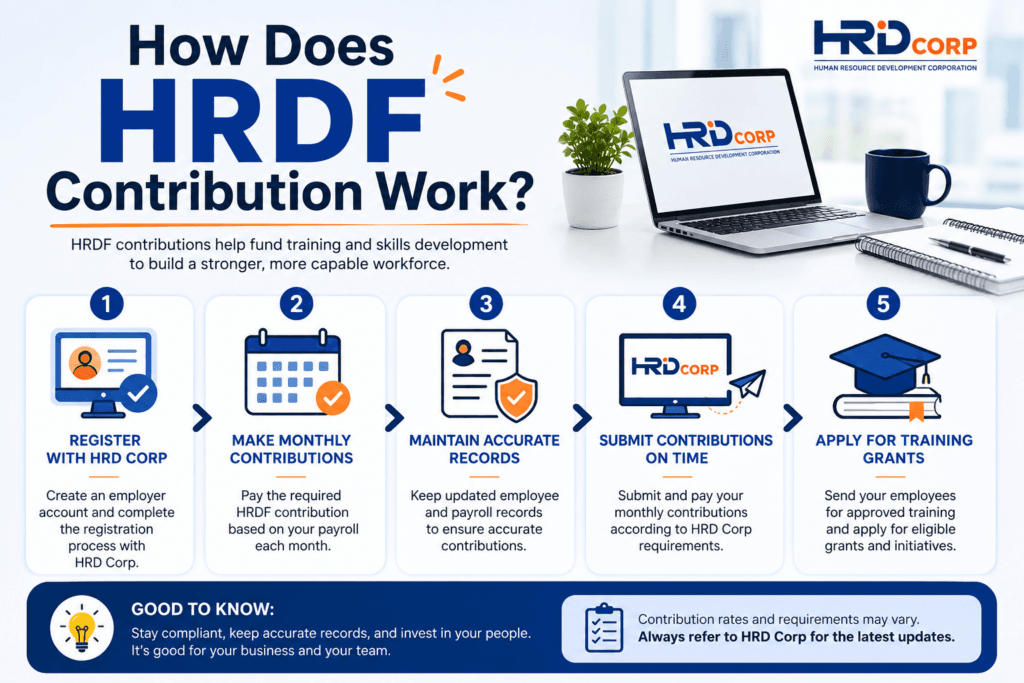
How Does HRDF Contribution Work?
Once an employer is required to register:
- Register with HRD Corp.
- Make the required monthly HRDF contribution.
- Maintain accurate employee and payroll records.
- Submit contributions according to HRD Corp requirements.
- Apply for eligible training grants when employees attend approved programmes.
Contribution rates may differ depending on employer category and current regulations.
Is HRDF the Same as EPF or SOCSO?
No.
Although employers often manage them together as part of payroll compliance, each serves a different purpose.
| Requirement | Purpose |
|---|---|
| EPF (KWSP) | Employee retirement savings |
| SOCSO (PERKESO) | Employment injury and social security protection |
| EIS | Employment Insurance Scheme |
| HRDF (HRD Corp) | Employee training and skills development |
As a result, understanding these differences helps employers avoid confusion when managing payroll and statutory obligations.
What Records Should Employers Keep?
Good record-keeping makes compliance much easier.
Employers should maintain:
- Employee payroll records
- Employee information
- Monthly contribution records
- Payment confirmations
- HRDF registration documents
- Training records
- Grant application documents (if applicable)
Having organised records can also simplify audits and internal compliance reviews.
Can Small Businesses Benefit from HRDF?
Yes.
Some SMEs assume HRDF only benefits large corporations, but many smaller businesses also make use of training programmes to improve staff capabilities.
Examples include:
- Customer service training
- Sales training
- Digital marketing courses
- Leadership development
- Accounting software training
- Cybersecurity awareness
- AI productivity training
- Occupational safety programmes
The available programmes and grant eligibility depend on HRD Corp’s current policies.
Common HRDF Mistakes Employers Make
Many HRDF issues arise because employers simply are not aware of their responsibilities.
Common mistakes include:
Assuming HRDF Does Not Apply
A business may have grown enough to trigger HRDF contribution requirements without realising it.
Regular compliance reviews are recommended, especially after workforce expansion.
Missing Registration
Some employers delay registration because they are unsure whether it is compulsory.
Checking early helps avoid future compliance complications.
Incorrect Payroll Records
Payroll errors can affect multiple statutory obligations, including:
- EPF
- SOCSO
- EIS
- HRDF
Keeping payroll records accurate helps reduce compliance risks across the board.
Missing Submission Deadlines
Late submissions may create unnecessary administrative issues.
Employers should maintain a compliance calendar covering all recurring statutory obligations.
What Happens If Employers Ignore HRDF Requirements?
If an employer is required to comply but does not:
- Registration obligations may remain outstanding.
- Required contributions may accumulate.
- Administrative issues may arise during compliance reviews.
- The business could miss opportunities to claim eligible employee training support.
The exact consequences depend on the circumstances and current HRD Corp regulations.
HRDF as Part of Overall Business Compliance
HRDF should not be viewed in isolation.
For many businesses, it forms part of a broader compliance framework that includes:
- Company tax
- SST obligations
- Payroll compliance
- EPF
- SOCSO
- EIS
- Accounting records
- Financial reporting
Managing these areas together helps businesses reduce administrative burden and maintain better operational control.
As a company grows, periodic compliance reviews become increasingly valuable to identify potential gaps before they become larger issues.
How SASCO Can Help
Understanding statutory obligations can be challenging, particularly for growing SMEs that are managing multiple compliance requirements at the same time.
SASCO supports businesses with Tax & SST Compliance services, helping employers maintain accurate financial records, understand their compliance responsibilities, and prepare documentation required for tax and regulatory purposes.
Whether you’re reviewing your payroll processes, preparing for business growth, or ensuring your accounting records are properly maintained, our team provides practical guidance with SME-friendly clarity.
If you’re unsure whether your business has additional compliance obligations beyond tax, speaking with an experienced advisor can help you understand the next steps.
Frequently Asked Questions
Is HRDF mandatory for every employer?
No. Whether HRDF contribution registration is mandatory depends on factors such as your industry, employee count, and current HRD Corp requirements.
Is HRDF different from EPF and SOCSO?
Yes. EPF focuses on retirement savings, SOCSO provides social security protection, while HRDF supports employee training and skills development.
How often do employers pay HRDF contributions?
Employers that are required to contribute generally make monthly HRDF contribution payments according to HRD Corp requirements.
Can employers claim training costs through HRDF?
Eligible employers may apply for training grants or other available initiatives, subject to HRD Corp policies and programme eligibility requirements.
Conclusion
HRDF is more than a statutory contribution—it is part of Malaysia’s effort to encourage continuous workforce development.
For employers, understanding whether HRDF applies, maintaining accurate payroll records, and keeping up with compliance requirements can help reduce administrative risks while supporting employee growth.
If you’re already reviewing your business compliance for tax, SST, payroll, or accounting, it is also worth checking whether your HRDF obligations have been properly addressed. SASCO can help you navigate these requirements with practical guidance tailored to your business needs.
Further reading: Sumbangan HRDF: Apa Majikan Perlu Tahu and EPF Employer Registration Guide (KWSP Majikan). For official reference, see HRD Corp.
Apa Kata Pelanggan Kami
Rating 5.0 daripada 29 ulasan Google

I really appreciate the continuous support, clear guidance, and helpful advice given throughout the process. It has been a smooth and pleasant experience dealing with such a dedicated and committed team.
Thank you once again for all the support and outstanding service. Keep up the great work!