Start Your Business with Confidence
From company incorporation to ongoing company secretarial services, SASCO helps Malaysian SMEs understand their compliance requirements with practical, straightforward advice.
Contact Us WhatsApp Us
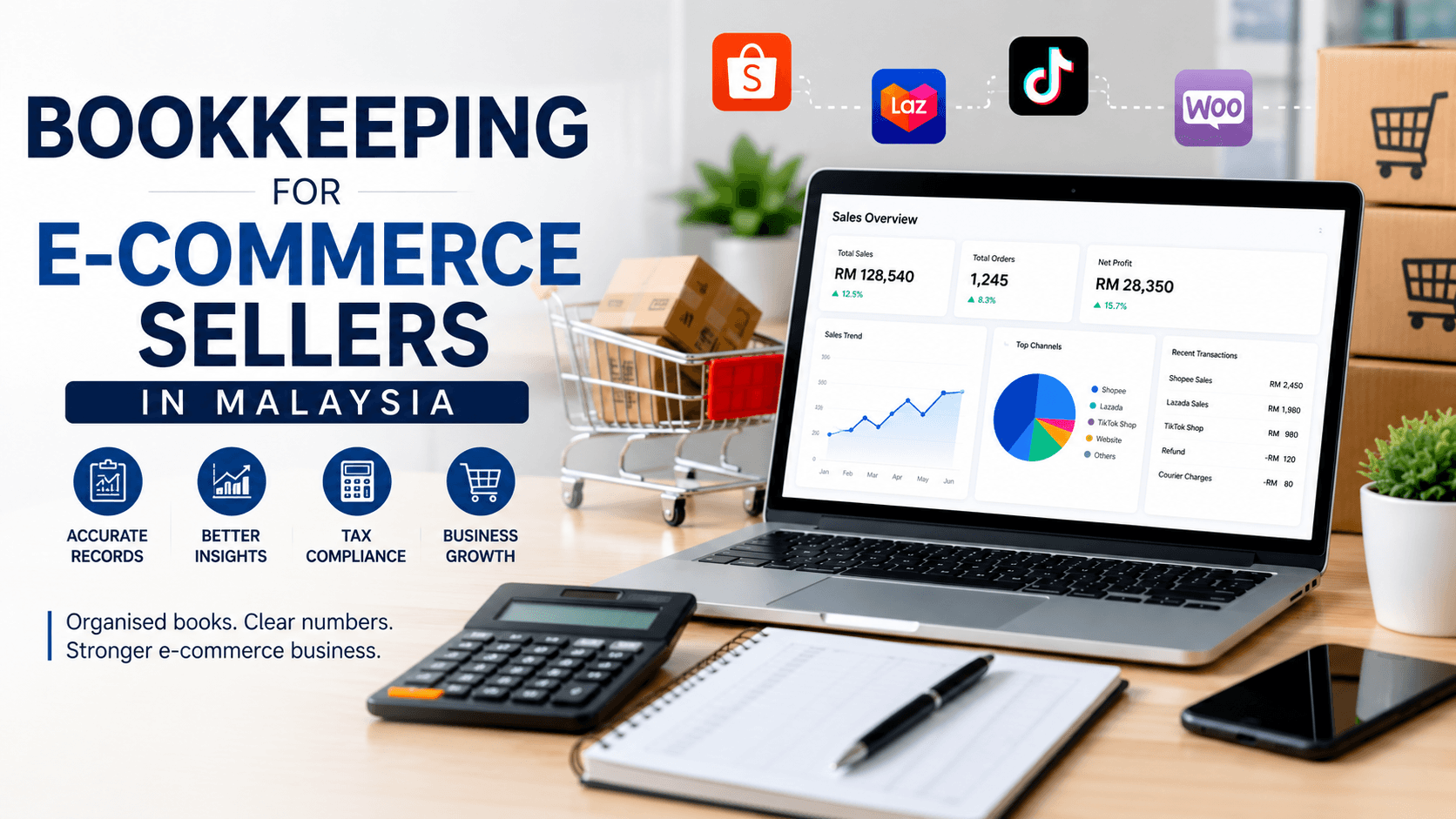
Running an e-commerce business is about much more than making sales. Whether you sell through Shopee, Lazada, TikTok Shop, Shopify, WooCommerce, or your own website, reliable bookkeeping for e-commerce sellers keeps every transaction organised and accurate.
As your business grows, bookkeeping becomes increasingly important. For example, sales from multiple platforms, payment gateway fees, courier charges, refunds, promotional discounts, and inventory movements can quickly make your accounts difficult to manage if everything is tracked manually.
Many online sellers only realise the importance of proper bookkeeping when they need to prepare financial statements, submit tax returns, apply for financing, or comply with regulatory requirements. By then, cleaning up months of missing or inaccurate records can take significant time and effort.
In short, professional bookkeeping for e-commerce sellers helps online businesses organise their financial records, improve visibility over business performance, and support ongoing compliance without disrupting daily operations.
Why Bookkeeping for E-commerce Sellers Matters
Unlike traditional retail stores, online businesses often receive payments from multiple sources while selling through different channels.
A typical month may include:
- Sales from Shopee
- Orders from Lazada
- TikTok Shop transactions
- Direct website purchases
- Bank transfers
- Payment gateway settlements
- Marketplace commissions
- Shipping fees
- Product returns
- Customer refunds
- Promotional vouchers
Without organised bookkeeping, it becomes difficult to answer simple business questions such as:
- How much profit did we actually make?
- Which sales platform performs best?
- Are inventory records accurate?
- Why is the bank balance different from reported sales?
- Are all expenses properly recorded?
Ultimately, proper bookkeeping provides the financial clarity needed to make better business decisions.
Common Challenges in Bookkeeping for E-commerce Sellers
Managing Multiple Sales Channels
Many sellers operate across several marketplaces while also maintaining their own website.
Each platform has different:
- Sales reports
- Commission structures
- Payment schedules
- Transaction fees
- Settlement reports
Combining these into one accurate accounting record requires careful reconciliation rather than simply recording bank deposits.
Recording Payment Gateway Transactions
Customers may pay using:
- Online banking
- Credit cards
- E-wallets
- Buy Now Pay Later (BNPL)
The amount received in your bank account may differ from the original sales value because of processing fees or platform deductions.
Bookkeeping should capture both the gross sales and the related charges accurately.
Tracking Inventory Properly
Inventory is one of the largest assets for many e-commerce businesses.
Poor inventory records can lead to:
- Stock shortages
- Overstocking
- Incorrect profit calculations
- Missing inventory
- Difficult year-end reporting
In addition, good bookkeeping works together with inventory management to provide a more accurate picture of business performance.
Handling Returns and Refunds
Returns are common in online retail.
Bookkeeping should properly record:
- Customer refunds
- Returned inventory
- Shipping adjustments
- Marketplace deductions
Otherwise, ignoring these transactions can overstate both revenue and profit.
Separating Business and Personal Expenses
Many SME owners still use personal bank accounts or credit cards for business spending.
Over time, this makes bookkeeping more complicated because every transaction needs to be reviewed individually.
Using dedicated business accounts helps keep financial records cleaner and easier to manage.
What Should Bookkeeping for E-commerce Sellers Cover?
Specifically, professional bookkeeping for e-commerce sellers usually includes several key activities.
Recording Sales Transactions
Sales from different channels should be consolidated into organised accounting records.
This includes:
- Marketplace sales
- Website sales
- Offline sales (if applicable)
- Customer payments
The goal is to maintain complete and accurate revenue records.
Expense Recording
Business expenses may include:
- Advertising costs
- Marketplace commissions
- Courier charges
- Packaging materials
- Software subscriptions
- Office expenses
- Staff salaries
- Professional fees
Proper categorisation helps produce meaningful financial reports.
Bank Reconciliation
Every bank transaction should match the accounting records.
Bank reconciliation helps identify:
- Missing transactions
- Duplicate entries
- Unrecorded fees
- Incorrect postings
Regular reconciliation reduces errors that can accumulate over time.
Inventory Recording
Depending on the business setup, bookkeeping may include recording:
- Inventory purchases
- Cost of goods sold
- Stock adjustments
- Inventory valuation
Accurate inventory records contribute to more reliable financial statements.
Financial Reporting
Regular financial reports help business owners monitor performance throughout the year.
Typical reports include:
- Profit and Loss Statement
- Balance Sheet
- Cash Flow information
- Accounts Receivable
- Accounts Payable
Together, these reports support budgeting, planning, and business decisions.
Why Accurate Bookkeeping Supports Compliance
Bookkeeping is not only useful for internal management.
It also supports various compliance requirements, including:
- Annual financial reporting
- Tax preparation
- Audit readiness (where applicable)
- Business financing applications
- Internal management reporting
As a result, where businesses are required to comply with Malaysian tax or e-Invoice requirements, accurate bookkeeping makes the preparation process significantly more efficient.
For any tax rates, filing deadlines, or e-Invoice implementation timelines, always verify the latest requirements with the relevant authorities before submission.
What Happens When Bookkeeping Is Neglected?
Small bookkeeping issues often become much bigger over time.
Businesses may experience:
Inaccurate financial reports
Poor records make it difficult to understand actual profitability and cash flow.
Time-consuming year-end cleanup
Missing invoices and incomplete records often require significant effort before accounts can be finalised.
Cash flow uncertainty
Without updated bookkeeping, business owners may not have a clear picture of available funds or upcoming obligations.
Difficulty preparing tax information
Incomplete records can delay tax preparation and increase the time needed to gather supporting documents.
Slower business decisions
Without reliable financial information, owners may struggle to plan inventory purchases, pricing strategies, or expansion opportunities.
How SASCO Supports E-commerce Businesses
Indeed, every industry has different operational challenges, and e-commerce businesses are no exception.
At SASCO, we provide industry-focused accounting and compliance support designed for Malaysian SMEs. Our team understands the day-to-day realities of online businesses, from managing marketplace transactions and inventory records to preparing financial reports that support better decision-making.
Our services can help businesses with:
- Bookkeeping and accounting support
- Financial reporting
- Bank reconciliation
- Compliance documentation
- Tax preparation support
- Ongoing accounting advisory for growing SMEs
Rather than applying a one-size-fits-all approach, we work with businesses to organise financial records in a practical and sustainable way, allowing owners to spend more time growing their operations.
In short, if you’re looking for bookkeeping for e-commerce sellers that understands your business, SASCO is ready to support you with clear, professional guidance.
Frequently Asked Questions
Do small e-commerce businesses need professional bookkeeping?
Yes. Even small online businesses benefit from organised financial records. Good bookkeeping helps track profitability, manage cash flow, and prepare for tax reporting as the business grows.
Can bookkeeping combine sales from Shopee, Lazada, and Shopify?
Yes. Professional bookkeeping can consolidate transactions from multiple sales channels into structured accounting records while maintaining proper documentation for each platform.
How often should bookkeeping be updated?
Monthly bookkeeping is common for many SMEs, although businesses with higher transaction volumes may benefit from more frequent updates to keep financial information current.
Is bookkeeping the same as accounting?
Not exactly. Bookkeeping focuses on recording daily financial transactions, while accounting involves analysing those records, preparing financial reports, and providing financial insights for business decisions. Together, both support effective financial management.
Ready to Simplify Your E-commerce Accounting?
As your online business grows, so do your financial responsibilities. Well-organised bookkeeping helps you stay on top of daily operations, prepare accurate financial reports, and support ongoing compliance with greater confidence.
Whether you sell through marketplaces, your own website, or multiple sales channels, SASCO provides bookkeeping for e-commerce sellers alongside industry-specific accounting and compliance support tailored for Malaysian SMEs. Contact our team to learn how our solutions can support your business growth.
Further reading: Accounting Services for Retail Businesses in Malaysia and Bookkeeping vs Accounting: What’s the Difference?. For official reference, see Royal Malaysian Customs Department (MySST).
Apa Kata Pelanggan Kami
Rating 5.0 daripada 29 ulasan Google

I really appreciate the continuous support, clear guidance, and helpful advice given throughout the process. It has been a smooth and pleasant experience dealing with such a dedicated and committed team.
Thank you once again for all the support and outstanding service. Keep up the great work!